New Study: Solar activity has a direct impact on Earth’s cloud cover

pia03149A team of scientists from the National Space Institute at the Technical University of Denmark (DTU Space) and the Racah Institute of Physics at the Hebrew University of Jerusalem has linked large solar eruptions to changes in Earth’s cloud cover in a study based on over 25 years of satellite observations.

The solar eruptions are known to shield Earth’s atmosphere from cosmic rays. However the new study, “The response of clouds and aerosols to cosmic ray decreases,” published in Journal of Geophysical Research: Space Physics, shows that the global cloud cover is simultaneously reduced, supporting the idea that cosmic rays are important for cloud formation. The eruptions cause a reduction in cloud fraction of about 2 percent corresponding to roughly a billion tonnes of liquid water disappearing from the atmosphere.

This new study, co-authored by Henrik Svensmark, is further validation of his game changing theory on the relationship of cosmic rays to cloud cover, and indeed, many important events in the history of the earth.


Measuring bias in the U.S. federally-funded climate research

curryja's avatarClimate Etc.

by David Wojick

Semantic analysis of U.S. Federal budget documents indicates that the climate science research budget is heavily biased in favor of the paradigm of human-induced climate change.

View original post 1,286 more words

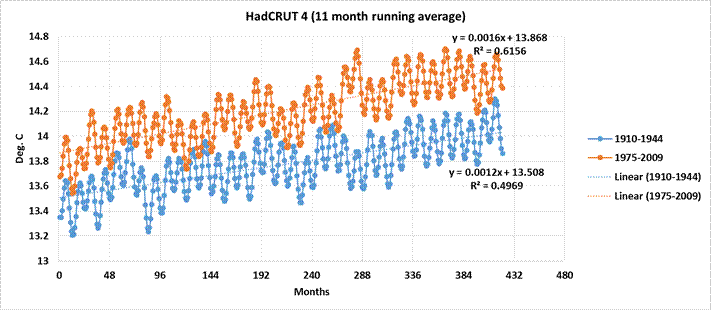
Virtually indistinguishable – Comparing early 20th Century warming to late 20th Century warming

Esper et al 2016 and the Oroko Swamp

Stephen McIntyre's avatarClimate Audit

Jan Esper, prominent in early Climate Audit posts as an adamant serial non-archiver, has joined with 17 other tree ring specialists, to publish “Ranking of tree-ring based temperature reconstructions of the past millennium” (pdf). This assesses 39 long tree ring temperature reconstructions. The assessment is accompanied by an archive containing 39 reconstruction versions, together with the underlying measurement data for 33 of 39 reconstructions. (It seems odd that measurement data would continue to be withheld for six sites, but, hey, it’s climate science.)

Because I’ve been recently looking at data used in Gergis et al, I looked first at Esper’s consideration of Oroko, one of two long proxies retained in Gergis screening.  I’ve long sought Oroko measurement data, first requesting it from Ed Cook in 2003.  Cook refused. Though Oroko reconstructions have been used over the years in multiproxy studies and by IPCC, the underlying measurement data has never made archived  The…

View original post 1,752 more words

Quiz: Which 30-Year Warming Period Is Recent?

Bob Tisdale's avatarBob Tisdale - Climate Observations

THREE MAPS ILLUSTRATING SIMILAR GLOBAL SURFACE TEMPERATURE CHANGES OVER DIFFERENT 30-YEAR PERIODS

The GISS map-making webpage allows users to create global maps of surface temperature anomalies for specific time periods or to create maps of the change in surface temperatures over user-defined time periods based on local linear trends.

My Figure 1 includes 3 maps from that webpage.  They are color-coded to show where and by how much surface temperatures have changed around the globe over three different 30-year periods, based on the GISS Land-Ocean Temperature Index (LOTI) data.  I’ve highlighted in red the respective global temperature changes in deg C.  They’re basically the same at 0.48 deg C and 0.49 deg C. You’ll note that I’ve also blacked-out the time periods, because I’ve asked the question Which 30-Year Warming Period Is Recent?

Figure 1Figure 1

View original post 2,153 more words