Wide Misuse of Land + Sea Surface Temperature

Several of the major datasets that claim to represent “global average surface temperature” are directly or effectively averaging land air temperatures with sea surface temperatures. These are typically derived by weighting a global land average and global SST average according to the 30:70 land-sea geographical surface area ratio. However, there is very little consideration of whether such a result has any physical meaning and what, if anything, it means.

One thing it does not represent is a metric of global surface heat content. However, this is one of the most common uses for such data.

climategrog's avatarclimategrog

Introduction

Several of the major datasets that claim to represent “global average surface temperature” are directly or effectively averaging land air temperatures with sea surface temperatures. These are typically derived by weighting a global land average and global SST average according to the 30:70 land-sea geographical surface area ratio. However, there is very little consideration of whether such a result has any physical meaning and what, if anything, it means.

One thing it does not represent is a metric of global surface heat content. However, this is ( often implicitly ) one of the most common uses for such data.

Temperatures don’t add !

In technical terms, temperature is not an extensive quantity. That is illustrated by the fact that if you have one bucket of water at 30 degrees Celsius and you add another bucket of water at 30 degrees Celsius, you do not end up with water at…

View original post 1,373 more words

El Ninõ and La Niña Driving Global Sea Surface Temperatures, Not Man-made Global Warming

Bob Tisdale updates us with his brilliant and very clear analysis of global sea surface temperature trends.

“…the sea surface temperature record indicates El Niño and La Niña events are responsible for the warming of global sea surface temperature anomalies over the past 32 years, not manmade greenhouse gases. Scroll back up to the discussion of the East Pacific versus the Rest of the World. I’ve searched sea surface temperature records for more than 4 years, and I can find no evidence of an anthropogenic greenhouse gas signal. That is, the warming of the global oceans has been caused by Mother Nature, not anthropogenic greenhouse gases.”

Bob Tisdale's avatarBob Tisdale - Climate Observations

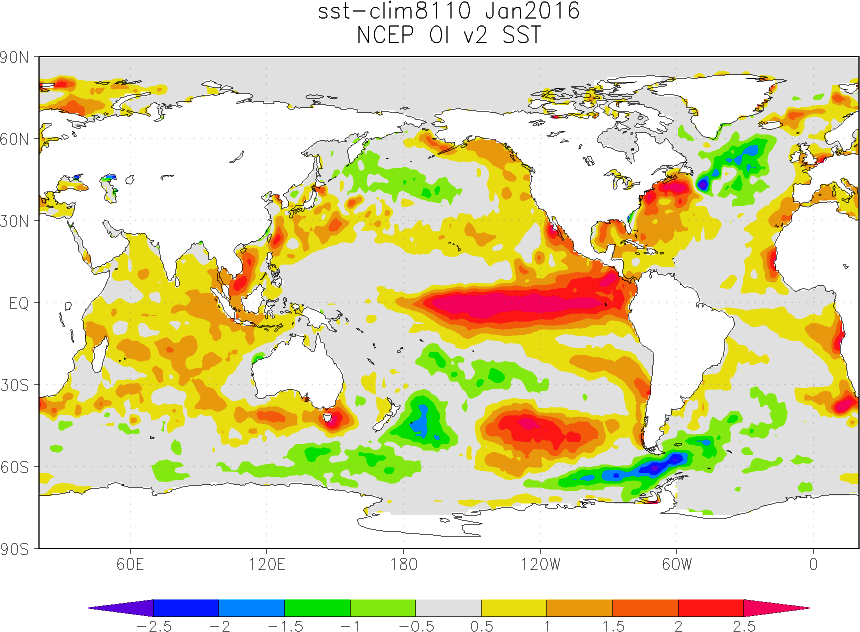
MONTHLY SEA SURFACE TEMPERATURE ANOMALY MAP

The following is a Global map of Reynolds OI.v2 Sea Surface Temperature (SST) anomalies for January 2016.  It was downloaded from the KNMI Climate Explorer. The contour range was set to -2.5 to +2.5 deg C and the anomalies are referenced to the WMO-preferred period of 1981-2010.

00 Map

January 2016 Sea Surface Temperature (SST) Anomalies Map

(Global SST Anomaly = +0.45 deg C)

View original post 3,101 more words

George Washington’s winters

by Judith Curry

Frozen rivers, knee-deep snows, sleet, frigid temperatures, and other winter miseries helped shape the story of George Washington’s life.

Source: George Washington’s winters

So my question is this. Why are we defining ‘dangerous climate change’ with respect to the climate of the 18th century, which was the coldest period in the last millennia, with wicked winters? Why not use a reference point of 2000 or 1970? The IPCC doesn’t provide a convincing explanation for the overall warming between 1750 and 1950; according to climate models, human causes contributed only a very small amount to the global warming to during this period (so presumably this overall warming was caused by natural climate variability). Co-opting the period between 1750 and 1950 into the AGW argument muddies the scientific and the policy waters.

A primer on the state of Climate Change Science

Anyone interested in a science-based understanding of Climate Change and the current state of the science, should read Dr. John R. Christy’s testimony before the U.S. House Committee on Science, Space & Technology from yesterday.

Climate Models Are NOT Simulating Earth’s Climate – Part 1

Bob Tisdale shows the blatantly obvious and essentially total failure of CMIP5 models to simulate ocean surface temperatures, which are a primary driver of climate.

“Unfortunately for the climate science community, the spatial patterns of the modeled warming rates for the global ocean surfaces from 1982 to 2015 (the era of satellite-enhanced sea surface temperature observations) show no similarities to the spatial patterns of the observed warming and cooling…no similarities whatsoever. This is blatantly obvious in Figure 1.”

Bob Tisdale's avatarBob Tisdale - Climate Observations

This post will serve as part 1 of the 2015 update of the model-data comparisons of satellite-era sea surface temperatures. The 2014 update is here. I’ve broken the update into two parts this year.

INTRODUCTION

The locations, the timings and the magnitudes of the naturally occurring variations in the surface temperatures of our oceans are primary factors that drive weather and, in turn, climate on Earth.  In other words, where and when the surfaces of the oceans warm, or cool naturally and by how much—along with other naturally occurring factors—dictate where and when land surface air temperatures warm and cool and where precipitation increases or decreases…on annual, decadal and multidecadal timeframes.

View original post 2,096 more words

Let’s talk about Global Cooling

The evidence is pretty clear that the globe is cooling on most time scales, and right now we are at one of the coolest points in the history of the earth. Looking first at the last 65 million years, since T-Rex was running around:

65_myr_climate_change_rev
Global Temperature estimates over the last 65 million years based on oxygen isotope thermometry of deep-ocean sediment cores from many parts of the world. Data from Zachos et al (2001). Graph by Robert A. Rohde. READ MORE…

The Medieval Warm Period in Antarctica: How two one-data-point studies missed the target

Violating the norms and ethos of science

Judith Curry gives a brilliant and thorough critique of a recent paper…

curryja's avatarClimate Etc.

by Judith Curry

Don’t let transparency damage science.  – Stephan Lewandowsky & Dorothy Bishop

View original post 1,925 more words

Undersea volcanoes may be impacting long-term climate change

reblogged from Climate Etc.
Undersea volcanoes may be impacting long-term climate change

by Alan Longhurst

I think this paper on on ocean tides, sea-floor volcanoes and Milankevitch cycles is a game changer.

Mid-ocean ridge eruptions as a climate valve

Maya Tolstoy

Abstract. Seafloor eruption rates and mantle melting fueling eruptions may be influenced by sea level and crustal loading cycles at scales from fortnightly to 100 kyr. Recent mid-ocean ridge eruptions occur primarily during neap tides and the first 6 months of the year, suggesting sensitivity to minor changes in tidal forcing and orbital eccentricity. An ~100 kyr periodicity in fast-spreading seafloor bathymetry and relatively low present-day eruption rates at a time of high sea level and decreasing orbital eccentricity suggest a longer-term sensitivity to sea level and orbital variations associated with Milankovitch cycles. Seafloor spreading is considered a small but steady contributor of CO2 to climate cycles on the 100 kyr time scale; however, this assumes a consistent short-term eruption rate. Pulsing of seafloor volcanic activity may feed back into climate cycles, possibly contributing to glacial/interglacial cycles, the abrupt end of ice ages, and dominance of the 100 kyr cycle.

M. Tolstoy, Mid-ocean ridge eruptions as a climate valve, doi:10.1002/2014GL063015, Geophys. Res. Lett. 2015 [abstract] [manuscript]

A post at WUWT includes the press release from Columbia University

The AGU also issued a press release [link]

300 Scientists Tell Chairman of the House Science Committee: ‘we want NOAA to adhere to law of the Data Quality Act’